 Menu
Menu
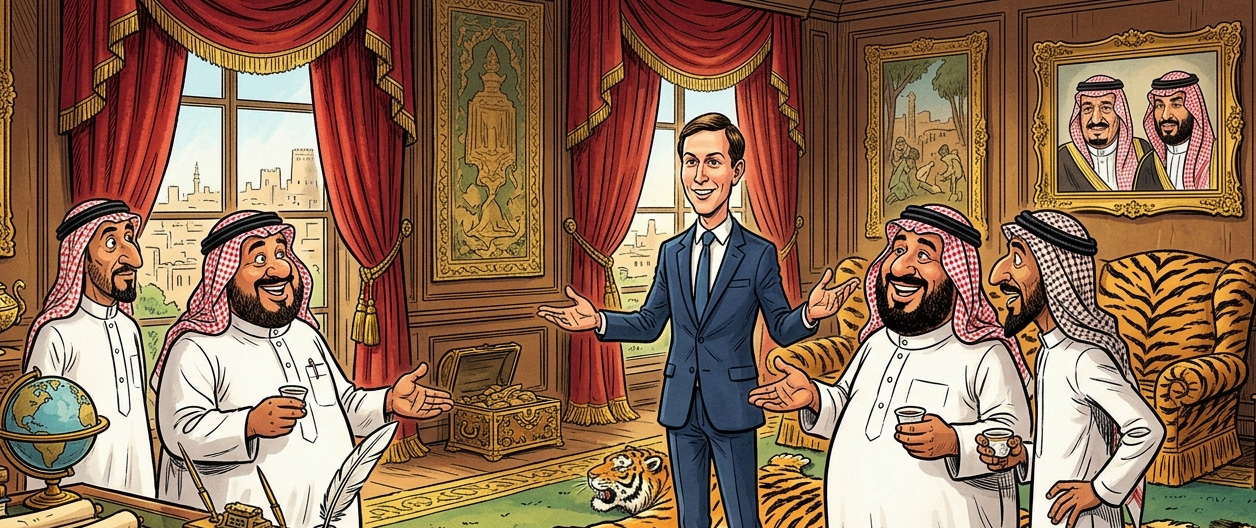
A Boy, a Bedroom, and a Future Prime Minister
Picture a comfortable home in New Jersey sometime in the 1990s. A Jewish real estate family is hosting a guest from Israel. The guest is important enough that the family's young son gives up his bedroom for the night and sleeps somewhere else in the house. The guest is Benjamin Netanyahu.
That boy was Jared Kushner.
This is not a rumor or a political attack. It was first reported by the New York Times and has since been confirmed by multiple outlets and acknowledged by Netanyahu himself, who joked at a White House press conference that he has known Kushner since he was a child.
Why does a childhood sleepover matter? Because thirty years later, that same boy would be sitting at the negotiating table as America's unofficial envoy to the Middle East, tasked with brokering a peace deal in a war where Netanyahu's government was one of the main parties. The man whose bedroom Netanyahu once borrowed was now the man America sent to negotiate with Netanyahu's government. If that sounds like a conflict of interest, that is because it is.
How Does a Real Estate Developer Become a Diplomat?
To understand how Jared Kushner ended up in this position, you need to understand one simple fact: he married the right person.
In 2009, Kushner married Ivanka Trump, daughter of Donald Trump. That connection eventually made him a senior White House adviser when Trump won the presidency in 2016. He was handed one of the most complex assignments in American foreign policy the Israeli-Palestinian conflict despite having zero experience in diplomacy, zero background in Middle Eastern politics, and zero government service of any kind. His only official title, then and now, is son-in-law.
His previous biggest professional moment had been nearly bankrupting his family's real estate company by buying a single Manhattan office building for $1.8 billion. That was his track record when Trump handed him the keys to Middle East peace.
Trump's explanation was simple: "I put Jared there because he's a very smart person, and he knows the region, knows the people, knows a lot of the players." And to be fair, Kushner did build real relationships in the Gulf states during the first Trump administration. Leaders in Saudi Arabia, Qatar, and the UAE came to trust him. He helped deliver the Abraham Accords in 2020, normalising relations between Israel and several Arab nations a genuine diplomatic achievement.
But here is the thing about those relationships. They did not stay in the past. They followed Kushner into his business life, and that is where the story gets complicated.
📅 Key Timeline
The $2 Billion Thank-You Note
When Trump lost the 2020 election, Kushner left the White House and did what many Washington insiders do. He cashed in.
He started a private equity firm called Affinity Partners in Miami. Private equity is a world where you raise money from investors, invest it, and take a cut of the profits. The problem was that Kushner had no experience in private equity either. No track record, no history of successful investments, nothing.
And yet, just months after he left the White House, something extraordinary happened. Saudi Arabia's sovereign wealth fund, controlled by Crown Prince Mohammed bin Salman, handed Kushner $2 billion. Not as a loan. As an investment in his brand new firm.
The Crown Prince's own financial advisors recommended against the investment. They said the fund had no track record, no clear strategy, no reason to justify $2 billion. The Crown Prince overruled them and sent the money anyway. When a ruler overrules his own experts to give money to a man who just spent four years shaping American foreign policy toward that ruler's country, most people do not call that a good investment. They call it a reward.
More money came. Qatar's sovereign wealth fund sent money. Abu Dhabi sent money. All told, Affinity Partners raised around $3 billion, almost entirely from Gulf governments that Kushner had worked with during his White House years.
And what did Kushner do with all that money? Largely nothing. By mid-2024, the firm had only actually invested about $1 billion of what it raised. The rest sat in accounts while Kushner collected management fees. By the Senate's count, he had pocketed around $157 million in fees from these foreign governments including $87 million from Saudi Arabia alone while returning essentially no profits to his investors.
The foreign governments investing in Affinity Partners may not have been interested in financial returns at all. They may have been buying access to the Trump family.
U.S. Senate Finance Committee finding, 2024Round Two: Back at the Table, Briefcase Still Open
In late 2025, with Trump back in the White House, Kushner returned to the diplomatic stage. Trump dispatched him to help negotiate a Gaza ceasefire alongside official envoy Steve Witkoff. The ceasefire came together, and Trump praised his son-in-law. Kushner then showed up in Moscow to meet Vladimir Putin. Then in Geneva to negotiate with Iran.
All of this while Affinity Partners was actively seeking $5 billion more from Middle Eastern governments including the very same Saudi Arabia whose sovereign wealth fund was already in his pocket.
Think about what that means in practice. Kushner sits down with Saudi officials to discuss American foreign policy. Those same Saudi officials are also considering whether to invest billions more in his firm. Every conversation has two agendas running simultaneously. Every outcome he negotiates affects not just American interests but his own bank account.
He was asked about this directly. His answer was remarkable in its confidence.
What people call conflicts of interest, Steve and I call experience and trusted relationships.
Jared Kushner, 2026The White House press secretary went further, calling ethics questions "despicable" and saying Kushner was "nobly donating his time to secure world peace."
The Netanyahu Problem
Here is where the personal history circles back with uncomfortable precision.
The man Kushner grew up knowing as a family friend Benjamin Netanyahu is the same man who has said publicly for decades that he wants to destroy Iran's military and political leadership. While Kushner was sitting across from Iranian negotiators in Geneva in early 2026, his partner Steve Witkoff had just been briefed directly by Netanyahu and Israeli defense officials before those very talks.
Shortly after those negotiations, bombs fell on Iran. The Iranian foreign minister said the talks had been conducted in bad faith. Diplomats who were in the room told American journalists that Tehran now believes the Witkoff-Kushner negotiating process was designed not to reach a deal but to keep Iran off guard before a military strike.
Whether that is true is a matter that has not been fully investigated. But consider the picture it paints. A man who grew up with Netanyahu as a near-family figure, who has financial ties to Saudi Arabia (which has its own interest in weakening Iran), who holds no official government title, who has been referred to the Department of Justice for potentially acting as an unregistered foreign agent was at the center of nuclear negotiations with America's most adversarial regional power.
The guy is literally on the payroll of the Saudi government and trying to take even more of their money while simultaneously hijacking U.S. foreign policy with his shadow State Department.
Senator Ron Wyden (D-OR), March 2026The Oldest Story in the Book
There is nothing entirely new about powerful people mixing public service with private profit. Washington has seen revolving doors for as long as there has been a Washington.
What makes Kushner different is the speed and the scale. Most officials at least pretend to separate their roles, serving the public first and collecting rewards later. Kushner has never really separated them at all. He is simultaneously the envoy and the fundraiser, the peacemaker and the dealmaker, the American representative and the man on the Saudi payroll.
And because he holds no official title because he is simply the President's son-in-law doing a favor the normal rules that would govern this kind of behaviour simply do not apply. There is no ethics filing required. There is no recusal process. There is no oversight board. There is just Jared, flying between capitals, talking to kings and prime ministers, then hopping on another call with potential investors from those same kingdoms.
What History Will Say
Jared Kushner may genuinely believe he is helping. He may genuinely believe that his relationships make him the right man for the job, that the deals he brokers are good for America, and that the money flowing into his firm is simply the market rewarding competence.
But good intentions do not dissolve conflicts of interest. A referee cannot fairly call a game if he has money riding on one of the teams. A doctor cannot objectively treat a patient if a pharmaceutical company is funding his clinic. And a diplomat cannot credibly represent one country when he grew up in the home of another country's leader and is simultaneously collecting billions from that country's neighbours.
The bedroom in New Jersey was just the beginning. The briefcase full of Saudi money is the middle. What the ending looks like, history has not yet decided.